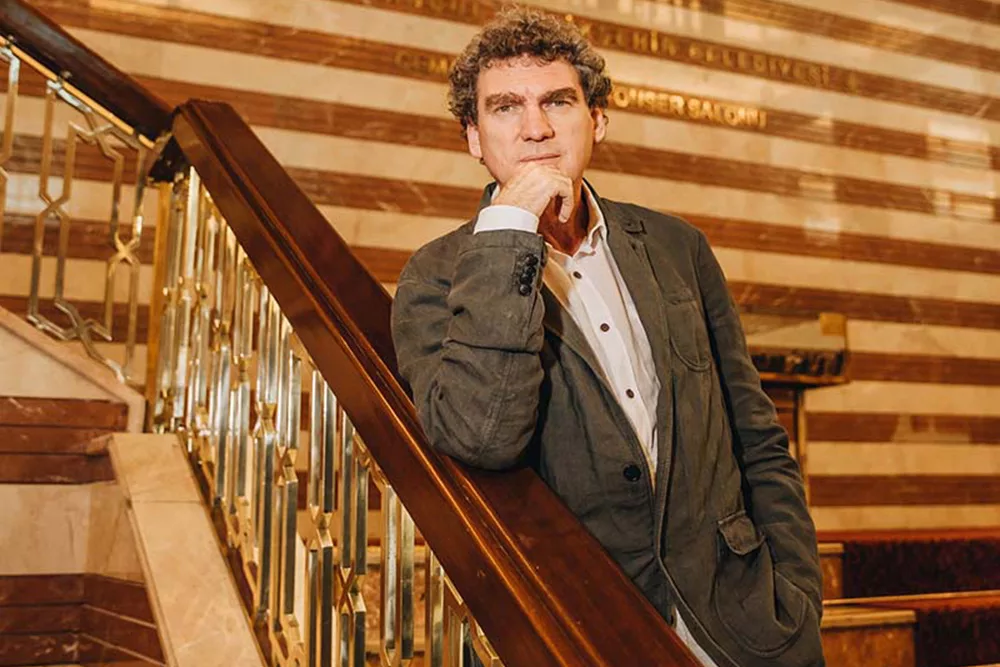
Cem Mansur is an artist who has conducted concerts worldwide, leading prominent organizations such as the Istanbul State Opera, Oxford City Orchestra, and Akbank Chamber Orchestra. He is also known for expanding his repertoire with forgotten masterpieces.
In October, he was appointed as the General Artistic Director of the Cemal Reşit Rey Concert Hall. A significant responsibility. CRR is a magnificent venue where spectacular concerts take place. We discussed everything from polyphonic music to music produced in the digital world, as well as his new role. The video will soon be available on our YouTube channel.
‘I DIDN’T WANT THIS ROLE’
First of all, congratulations on your new position. Did you leave the Turkish Youth Philharmonic Orchestra?
I didn’t leave. Why would I? It’s my favorite, the most valuable thing I’ve done. I will continue with it. It doesn’t negatively impact each other as it’s a project that continues in the summer.
So why did you want to take on this role?
If I said I wanted this role, that would be a lie. I’m surprised I didn’t want it, or rather, it didn’t occur to me. Because I have quite a history in this hall. I’ve experienced meaningful things at the CRR Concert Hall. However, for the past nine years, the issue of employment for young conservatory graduates has kept me constantly occupied. The positions in state orchestras are insufficient. Since new positions were not granted, I started talking to municipal authorities. While discussing the social role and importance of music as a tool for societal peace, they offered me this place. I am someone who loves to create different programs, combine themes, and, most importantly, share music. So, I gladly accepted, and I’m glad to be here. It’s a valuable platform for sharing what I believe in regarding music.
What will happen in this concert hall in the new period?
The identity of the concert hall has changed very quickly. It’s natural for the identity of cultural centers to change with their general art directors. CRR has returned to its original purpose. Every kind of music should be performed well here. However, while saying everything to everyone, one should not fall into traps. Some things are not suitable for this stage, such as classical ballet, folk dances, pop music… It can host the best of many genres outside of these. You can see this from the programs of the first few months. Both entertaining and educational.
‘THEY CAN’T REQUEST WHAT THEY DON’T KNOW’
Can we say that you aim to appeal to broad sections of society?
I don’t believe in distinctions like ‘this music appeals to the broad sections of society, this music appeals to narrow sections.’ In fact, I don’t like the distinctions between East and West either. There is an orchestra called the Cemal Reşit Rey Symphony Orchestra, consisting of colleagues who perform under different institutions. We are trying to organize them. We will repeat the December concert in some districts.
This is quite innovative for Istanbul. We want to take the orchestra to districts where people haven’t thought about listening to classical music but deserve to share music. We feel obliged to share something that makes our lives so exciting and profound with everyone. This is, first of all, a public service. Everyone has the right to good music. They ask, ‘Is there demand, how many people listen?’ People don’t request something they don’t know.
I want to touch on your profession a bit. I have admired the profession of conducting orchestras since my childhood, but I still haven’t fully grasped what it is…
This is something that is rightly very curious. When you look at the orchestra, you see something shared consisting of sound, but the only person not making a sound is the one in the middle… An orchestra is one of the communities formed by different sounds coming together to achieve something. This is the essence of polyphonic music. The emergence of the orchestra conductor is related to the performance of music in concert halls open to the public from the mid-18th century onwards.
With the growth of orchestras and the music becoming more complex, the need arose for someone to separate from the orchestra and make decisions. The conductor’s responsibility begins here. He has to make decisions. The person who brings the composition to life centuries after it was written is the orchestra conductor. So, it looks mysterious, cool, but what really matters is what people hear. It has its difficulties, but looking at it from the perspective of the depth it requires, technical knowledge, and psychological equipment for human management, it is the most challenging branch. Such an odd position.
When you look at the categories of Eastern and Western music from a technical and content perspective, how do you evaluate them?
I don’t like the distinctions between subculture or high culture. I don’t like the distinctions between East and West either. Is a symphony written by a Japanese composer Western music? It depends on your perspective. All music genres are not things that flow in different lanes, competing things. There was not such a clear separation between popular music and what we call high culture music until recently. Mozart wrote some operas for the palace theater and some for the public theater. ‘Great composers do not write popular music, do not work for money, do not write jingles’…
I’m sure if Beethoven lived in this era, he would write jingles as well. But of course, we shouldn’t put his great symphonies in the same category as short-lived pop songs. The issue of progress is something often confused in music. Mozart, Tchaikovsky came after Bach. Is Bach back? There’s nothing more advanced in the human mind than Bach. Therefore, there is change, but not much progress.
‘SUPPORTING ART IS EVERYONE’S RESPONSIBILITY’
I want to ask a question with political foundations. Who should support art?
In civilized societies, support for art should not belong to a single entity. It should be a shared responsibility of the state, local governments, non-governmental organizations, and the private sector. If we can share something of very high quality at very reasonable prices at the CRR Concert Hall, it is thanks to local governance. There are also other things thanks to the private sector. It must be acknowledged that highly polyphonic music at a certain level requires support. You can’t make every ticket 1,500 liras. If a 100-person orchestra performs, there is a cost to it.
This is a profession; people make a living from it. So, just selling tickets and passing by is not realistic. It’s not the same as the concert of four pop artists in an 80,000-seat stadium. The math doesn’t add up. You might say, ‘If it doesn’t add up, why is it being done?’ but the real issue is what can be gained for civilization through these institutions. It’s not a simple supply-demand calculation. Symphony orchestras exist in societies where there is democracy, freedom of expression, and sewage does not flow in front of your house. This is a package. What we call civilization. Many-voiced music is a primary institution that expresses what it means to be civilized and a democratic human.
‘THERE’S NO RETURN FROM THE ATTACK’
To get to know you better, I would like to ask a question: What theme concerns you the most?
Things that have no return, such as things done to nature. Things like the Istanbul Canal… Things that are allowed to be done to fill the pockets of some people, knowing that the results will lead to nothing but disaster… These are what bother me the most. Some things have a return, but there is no return from the attack on the treasures of nature and history. Every day we read something sad happening in Turkey on this issue.